Sales, Human Rights Photographs, and the Platform Economy: The Digital Afterlife of an Anti-Apartheid Image
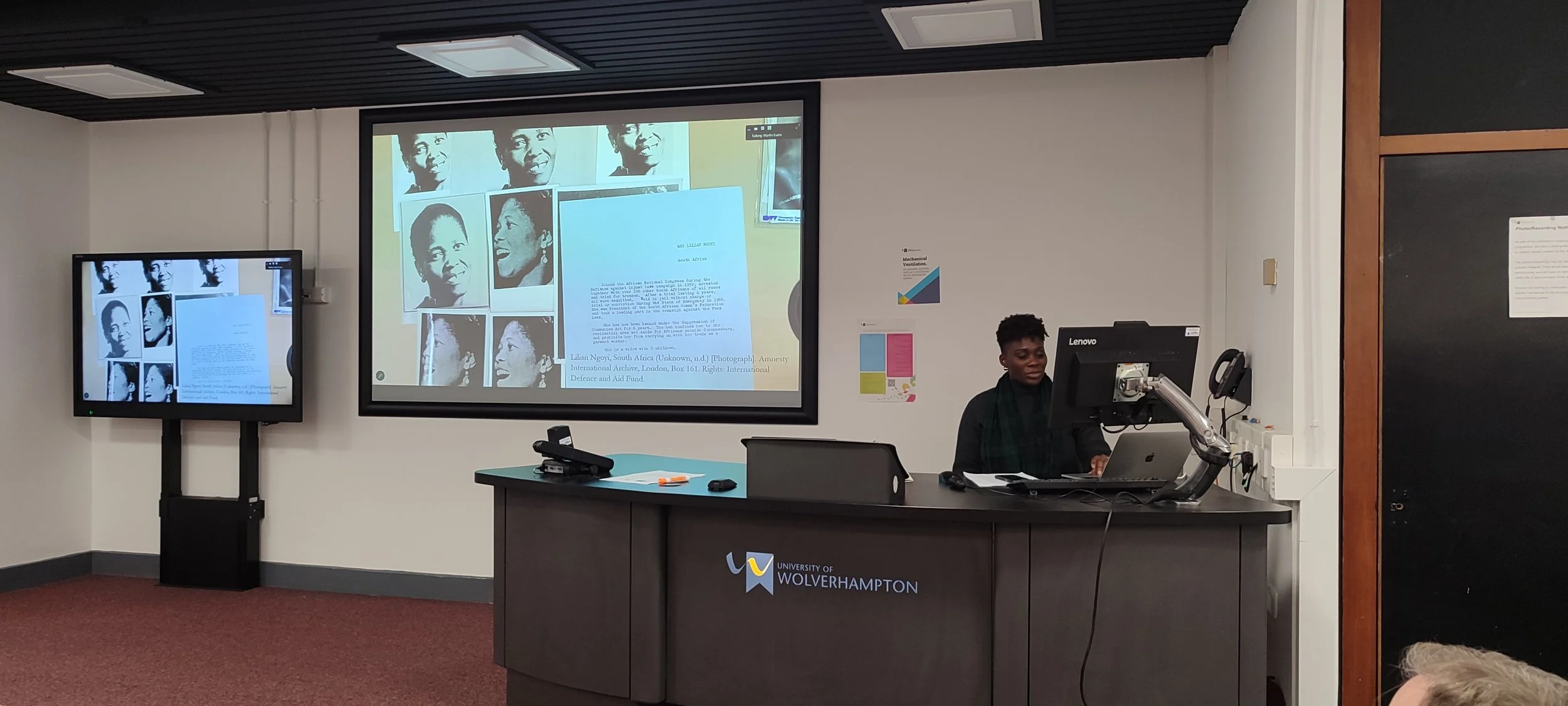
Presenting a paper at the Royal Photographic Society Historical Group at University of Wolverhampton, 2026
Slide 1
Sales, Human Rights Photographs, and the Platform Economy: The Digital Afterlife of an Anti-Apartheid Image
Slide 2
Who owns the digital remains of the dead? Are we in a new age where the sustainability and preservation of cultural materials are undermined for the sake of profits, especially archival images with precarious origins? These are the questions that have sat with me since I went to South Africa and found an original photograph of a late human rights activist on Amazon for sale. These are the questions I also want you to think about with me, especially looking at certain genres of photography in motion and the platform economy.
I begin.
It was on a hazy afternoon, seated in Amnesty International’s London office. I was studying images of South African anti-apartheid activists seeking context beyond the sparse, archival data of names, dates, and case references. This archival data is the basic annotation practice in Amnesty’s photographic archive. Some of the images did not have well-documented archival data owing to the nature of the anti-apartheid activism that flowed from South Africa in the sixties to Britain. Many photographers who worked for newspapers or independently did not want their work attributed to them for the sake of avoiding imprisonment or persecution.
So images from South Africa were sometimes displaced from the original photographers. While the collective aim was to see apartheid end, historically, this was also a problem.
As I sat in Amnesty’s archive, contending with the process of archival activation, seeking context for most of the images. I encountered the photograph of Lilian Ngoyi, who was one of my case studies in my thesis on Amazon, tagged as “Vintage photo of South African Personalities: Mrs Lilian Ngoyi, President of the Women's League of the African National Congress, and she is reportedly under arrest. 1960.” It was credited to the International Magazine Service photo archive. This was the same image Amnesty used in its 1978 report advocating for Lilian Ngoyi, who had been subjected to a banning order under the apartheid regime.
This singular encounter challenged me to think critically about the digital remains of historical photographs embedded in a transnational human rights network and how these images become endangered when they transition into what I describe as an unplanned or unintended digital afterlife.
Slide 3
Digital afterlife refers to an active or passive digital presence following one's death. This presence may have been created intentionally or unintentionally and mediated as digital media artefacts. These can be in the form of photographs, social media profiles, and digital memorial sites that continue to mediate the identities of the dead forever or for a limited time.
I argue that the threat of platform society, such as Amazon, to such historical images often detaches them from their original political and ethical contexts. Once part of a transnational advocacy network, they are reshaped by platform capitalism as a commodity. For instance, in this digital afterlife on Amazon, the photograph of Lilian Ngoyi was transformed into a commercial material rebranded as a “vintage” collectable, now performing in the same category as a stock photograph.
This case provides a critical entry point for examining the contemporary trade of stock photographs of human rights subjects. Following Paul Frosh’s signification that historical photographs risk commodification, displacing their political resonance. This paper argues that platform-mediated circulation reframes photographic heritage within global networks, raising urgent concerns about preserving images rooted in human rights history.
Slide 4
Who was Lilian Ngoyi, and what was her connection to Amnesty International? Lilian Ngoyi was a sharp political leader in the anti-apartheid struggle in South Africa.
Her rise to public prominence was partly due to unexpected events. The 1950s had a significant impact on the political landscape as Lilian Ngoyi spearheaded protest marches and defiance campaigns. Her devotion to public disturbances in the apartheid system led to her emergence as the first woman elected to the National Executive Committee of the African National Congress.
She was charged under the Suppression of Communism Act in 1962. An act defined broadly to ban or isolate individuals that the state considered to be communist. By 1972, Lilian Ngoyi was in and out of ban orders, solitary confinement, and detention. She was not to be quoted in the media.
A banning order later prohibited her from attending political or social gatherings. So began the authority's use of banning orders to silence the presence of Lilian Ngoyi, both in public, until she died.
Easily, the context surrounding such a historical figure has continued to suffer absences in British archives. But on a global platform, she is being signified as a piece of commodity for consumption. This is an example of what happens to photographs when they take on a new functionality and meaning. Especially meaning anchored in the new cultural economy and their mediators, whose motive is profit over ethics or preservation.
This dislocation of context leaves the photographic object in a vulnerable position of impermanence when they assume new owners. I like how Paul Frosh (2001) describes it in the realm of stock photography: The significance of stock photography is at odds with its economic intent. For a stock image to attain optimal success, it must be versatile enough for use in diverse contexts and purposes, including some unforeseen by the photographer or agent. The new meaning may also arise from its interaction with other images and words when they coexist in a social context or are presented to various audiences.
In the case of Lilian Ngoyi, the context, such as the state power attempting to erase her struggle, did not manifest in Amazon's sales pitch. However, Lilian’s case was picked up as a concern for the network of British transnational human rights actors, such as Amnesty International.
Slide 5
Lilian’s photograph began exchanging within the hands of this network of human rights actors in London. Amnesty cited that the photograph was received from an organisation called the International Defence and Aid Fund. A British organisation formed by Canon John Collins in 1956. International Defence and Aid Fund (IDAF) was known to operate both overt and covert missions in South African apartheid. Although after a decade of active activism and advocacy against apartheid, IDAF was banned in South Africa, and the organisation moved to London. IDAF had served as a bridge between various institutions and regions in the information campaign against apartheid. For instance, in Amnesty’s archive, IDAF’s presence was there; in the Anti-Apartheid Movement’s archive, their presence was also there. In fact, IDAF's archive has been described as a trove containing stories of detention, trials, imprisonment, exile, suffering, and activism by individuals and families during apartheid and the liberation struggle (Frieslaar 2015). It is no wonder that Paddy Donnelly, a former IDAF photo officer, said the organisation was a source of high-quality propaganda.
Slide 6
To be honest, IDAF received credit for several images found in Amnesty’s photographic archive, some with clear archival data and some without. These photographs, which IDAF shared from South Africa, represented political prisoners with various ideologies and economic classifications and further exposed the politics of the human rights information campaign. Photographic exchange and circulation played an important role in British transnational human rights politics. Transnational advocates are aware of the impact that a one-sided idea or exchange could have on a human rights information campaign. Such politics of human rights, as Cmiel says, is a politics of spreading information and images from one side of the world to another, often minimising local context.
Slide 7
It was unsurprising to see Lilian Ngoyi’s photograph enter this space of the platform economy in this digital afterlife with a new meaning and functionality. For a photograph that began to circulate in the 70s. But the hands of circulation have shifted from transnational advocates to stock image production - solely intended to sell photographs for advertising and marketing activity. As with the age of global flux and shifting in photographic use, we are seeing specific types of photographic genres, such as historical photographs, feature in this industrial boom.
When I say 'photographic genre', I am referring to human rights photographs and humanitarian photographs. These are images based on shared conventions produced from atrocity, violence, or aid. And sometimes these images were never created to be seen in such a classificatory regime. Lilian’s photograph was created as part of professional headshots for the new ANC leaders by Eli Weinberg in the fifties. It had no intentions to be seen mediating as a human rights image.
When Frosh (2001) also argues that the system upon which stock photography operates is designed to favour the photographer who bears the production costs of these images but does not incur distribution costs. I wish this applied to photographers like Eli Weinberg.
In the case of this photograph, it took me travelling to the Mayibuye archive in South Africa to locate the original photographer, Eli Weinberg. I was told he handed over his archive to the International Defence and Aid Fund (IDAF) before he died in exile and impoverishment.
It is not only Amazon that has access to this photograph of Lilian Ngoyi; some artists have reproduced it multiple times with no attribution to the photographer. These are the urgent concerns:
- The photographer does not earn, the image has lost its original resonance
- It has a new owner
- Licensing boundaries are blurred when seen on an e-commerce platform, as opposed to being listed for editorial use
- Mayibuye archive did not know this photograph was for sale on Amazon
Slide 8
This image is now part of a new visual economy that is digital and commercial. I borrow the term visual economy from Deborah Poole, which encompasses production, value, and use of such photographs.
This photograph takes on a new dimension as a result of technological advancements and evolving capitalism in its afterlife. Lilian Ngoyi may have been remembered in South Africa as one of the icons representing the women’s contribution to the end of apartheid, but she also died in poverty. The irony is that her personal narrative was one devoted to the national struggle. But in its afterlife, the material photograph of Lilian Ngoyi is now a commercial product.
We must contend with this type of social order – the commercial value of photographs and the subject within - as Poole suggested that images have a direct connection to the political and class structures of society if we pay attention to the production and exchange of material goods or commodities.
I agree, look at the vulnerability of the heritage sector being defunded and the encroachment of the platform economy undermining preservation efforts. We must contend for a return to community-driven efforts to share resources or even consider transnational archival collaboration to steward ethical preservation of human rights objects.
Slide 9
Thank you.
Bibliography
Cmiel, K. 1999. The Emergence of Human Rights Politics in the United States. The Journal of American History 86(3), pp. 1231–1250. doi: 10.2307/2568613.
Castells, M. 2005. The Network Society: From Knowledge to Policy. In: Castells, M. and Cardoso, G. eds The Network Society from Knowledge to Policy. Washington DC: John Hopkins Center of Transatlantic Relations
Frieslaar, G.L.A. 2015. (RE)COLLECTIONS IN THE ARCHIVE: MAKING AND REMAKING THE INTERNATIONAL DEFENCE AND AID FUND (IDAF) ARCHIVAL COLLECTION. Doctor of Philosophy in History, South Africa: University of the Western Cape.
Frosh, P. 2001. Inside the image factory: stock photography and cultural production. Sage Journals, pp. 547–692. doi: 10.1177/016344301023005005.
Is there a digital afterlife. 2025. Available at: https://drupalwebprod-files.up.ac.za/Public/media/462/documents/inline/3275338/news-release-is-there-a-digital-afterlife.zp268610.pdf?VersionId=q0BaUf0fJ5nAUfJHiRmmVqysGuD9VYFB [Accessed: 4 March 2026].
SAHA / Sunday Times Heritage Project - Memorials. [no date]. Available at: https://sthp.saha.org.za/memorial/articles/the_private_letters_1971_72.htm [Accessed: 4 March 2026].
Schwaid-Lindner, W. 2025. Byte the Hand That Feeds: Late-Stage Capitalism’s Grip on Digital Preservation. Journal of Radical Librarianship 11, pp. 89–116.
Serafini, L. 2021. Post-Symbolic Images in Platform Capitalism: An “Impolitical” Aesthetic Space. Materiali di Estetica. Terza serie (8.2).
The International Defence and Aid Fund (IDAF) | South African History Online. [no date]. Available at: https://sahistory.org.za/article/international-defence-and-aid-fund-idaf [Accessed: 4 March 2026].
